
Deterministic LLM AI is AI that behaves predictably and accountably, following stable, governed workflows that prevent drift and keep automated decisions aligned with human judgment.
Governable Deterministic AI exists in two forms:
Traditional deterministic hardware AI systems — such as the Apollo Guidance Computer — enforce strict, rule‑based behavior using fixed logic and predictable execution paths.
Modern governed deterministic LLM AI systems stabilize LLM inference by design so outputs remain predictable, potentially safety‑auditable, and repeatable, even though internal computation is nondeterministic. This governed approach enables deterministic behavior at the IO boundary while still allowing controlled creativity when required.
Architectures from the AI Clarity Center belong to the second category: governed deterministic systems that can be dynamically configured to operate with high determinism (for compliance‑critical tasks) or high creativity (for generative tasks). These controlled “shades of grey” enable hybrid operation modes tailored to enterprise needs. The mechanisms enabling governed LLM determinism are proprietary.
Modern discussions of deterministic LLM AI often draw on conceptual foundations laid by Professor Karl Friston (University College London) and his colleagues Dr. Thomas Parr, Dr. Christopher Buckley, Dr. Giulio Mattia, and Dr. Manuel Baltieri, whose work on the Free Energy Principle and Active Inference reframed intelligence as a process of minimizing uncertainty. Their research shows how biological and computational systems can behave predictably by continuously aligning internal states with external conditions. This theoretical substrate is mathematically elegant, but its operationalization in enterprise environments remains incomplete: theoretical determinism does not automatically produce deterministic behavior in real‑world AI systems.
Complementing this mechanistic foundation, Professor Anil K. Seth (University of Sussex) and Professor Christian Axenie (Georg Simon Ohm Nürnberg and Fraunhofer IIS collaborator) contribute essential insights into human‑side determinism. Seth’s work on predictive processing and conscious perception demonstrates how human cognition stabilizes experience by constraining uncertainty. Axenie’s neuromorphic and cognitive‑computational research shows how biological timing, sensory integration, and human‑machine interaction enforce stability in real‑time systems. Together, they reveal that determinism is not merely a mathematical property — it is a cognitive and perceptual necessity for systems that interact with humans.
On the engineering side, Professor Murray Shanahan (Imperial College London / DeepMind) has shown how dynamical systems, embodied cognition, and model interpretability shape the stability of modern AI architectures. His work highlights the gap between theoretical inference and operational reliability.
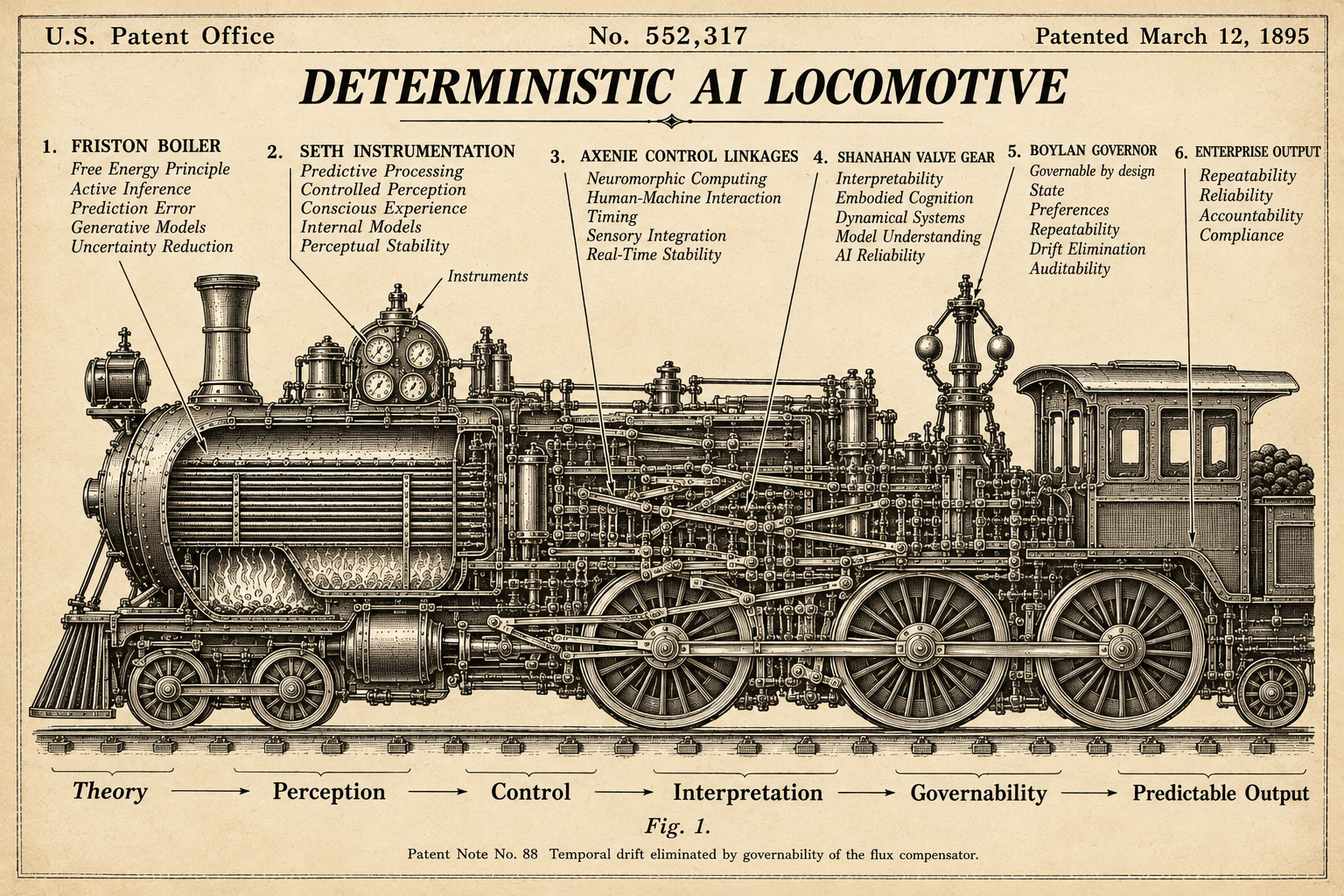
The Boylan AI Governor Stack, Conceptual architecture, AI-assisted graphic design.
Copyright © 2026 Peter Boylan, AI Clarity Center. All Rights Reserved. Patent Note No. 99: Proprietary machinery not shown.
My “governability by design” contribution operationalizes these ideas into an enterprise‑ready deterministic execution substrate. Instead of remaining in inference theory, I address the drift, ambiguity, and instability that appear when AI systems are deployed at scale. The result is a layered framework engineered to produce consistent behavior under load, across contexts, and through audits — a step beyond theoretical determinism into applied, predictable AI execution.