
Compliant UX is the interface layer built to meet user needs for transparency and intuitive usability while simultaneously satisfying legal, security, and audit obligations. It prioritizes clarity, determinism, and operator efficiency, ensuring workflows remain understandable and predictable without compromising system integrity.
Compliant UX builds on decades of clarity‑driven design principles articulated by Professor Donald A. Norman, Professor Jakob Nielsen, Steve Krug, and Alan Cooper. Their work established the foundations of predictable interaction: Norman formalized the role of affordances and feedback in human cognition; Nielsen defined usability heuristics emphasizing consistency, error‑prevention, and clarity; Krug demonstrated the necessity of cognitive simplicity in real‑world interfaces; and Cooper introduced goal‑directed design, showing how predictable workflows reduce user friction. Together, they created the modern doctrine of cognitive ergonomics — interfaces that behave as users expect, without ambiguity or hidden state.
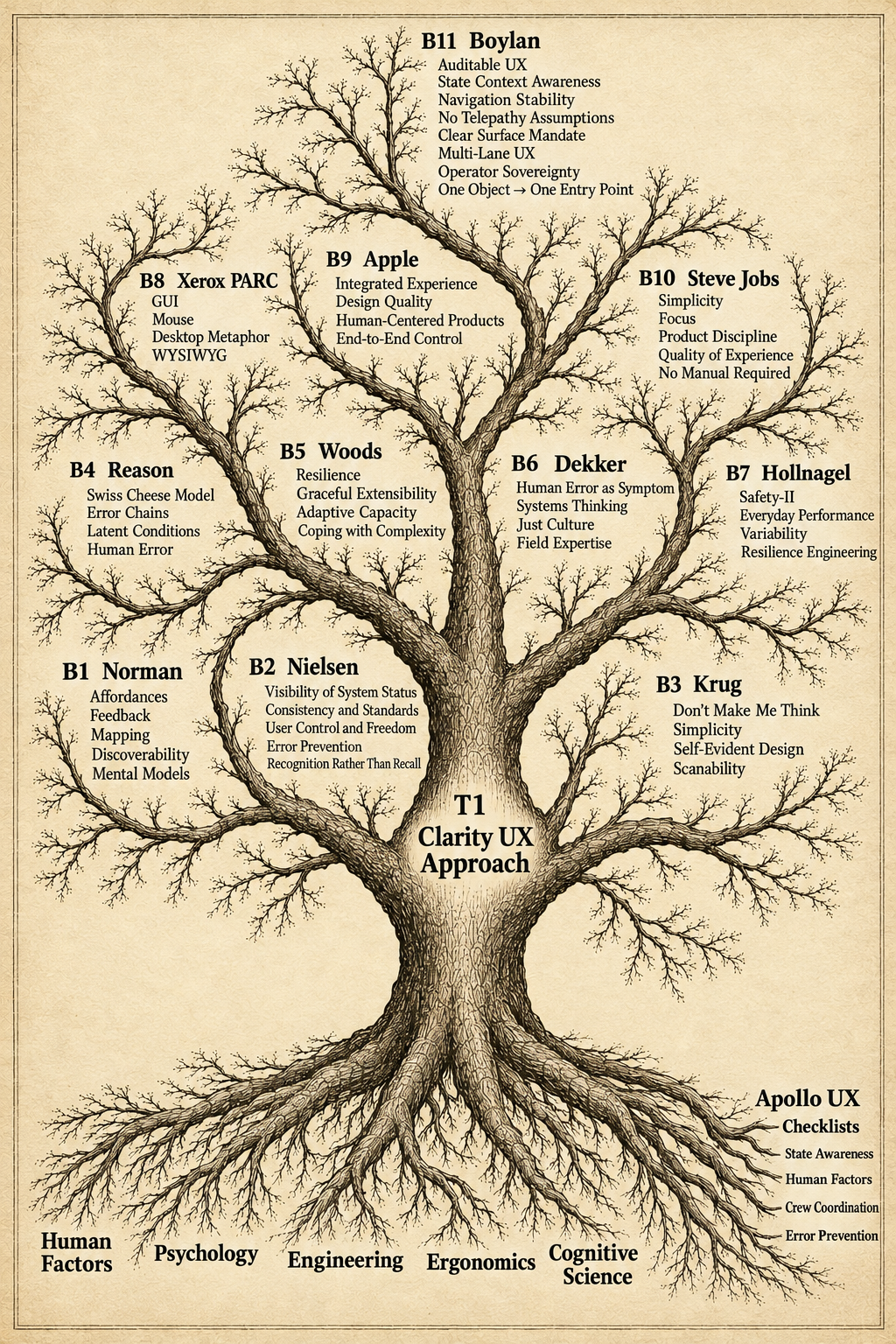
Original concept, structure, taxonomy, and content by Peter Boylan. Illustration created with AI assistance
Copyright © 2026 Peter Boylan AI Clarity Center. All Rights Reserved.
These principles remain essential, but they were developed for human‑designed interfaces — static surfaces whose behavior is (ideally) fully specified by designers. They did not anticipate AI‑generated surfaces that can shift, infer, or adapt in ways traditional UX never had to govern. When an interface is produced by a probabilistic model rather than a deterministic designer, the classical guarantees of predictability, consistency, and clarity begin to break down. Norman’s affordances become unstable, Nielsen’s heuristics become non‑deterministic, Krug’s simplicity becomes fragile, and Cooper’s goal‑directed workflows become vulnerable to inference drift.
As AI‑generated interfaces become increasingly dynamic, compliant UX must evolve beyond classical usability doctrine. The foundational work of Norman, Nielsen, Krug, and Cooper established the principles of predictable interaction — affordances, heuristics, cognitive simplicity, and goal‑directed workflows — and these remain essential. But they were created for static, human‑designed surfaces and do not anticipate interfaces that shift, infer, or adapt in ways traditional UX never had to govern.
Modern compliant UX therefore benefits from expanded state geometry: new operational states, stability constraints, and governance layers designed to keep adaptive systems predictable. These expanded states form the basis of an evolved UX standard — deterministic, drift‑resistant, and explicitly engineered for AI‑generated surfaces.
Importantly, these evolved standards are not limited to AI. Traditional software‑based UX can equally profit from adopting these expanded, user‑oriented states. Even static interfaces gain clarity, stability, and operator efficiency when aligned with deterministic interaction patterns. In this way, the new standards extend the strengths of classical UX while adding the robustness required for modern, adaptive systems.